Tuesday, June 12, 2018

Kaala - Movie Review


Ever since Rajinikanth reached the heights of superstardom, his movies have always been extravagant, larger than life and a display of his charismatic style. But, no matter how well his last few movies fared at the box-office, I was largely disappointed by almost all his movies since the 2010 release, Robot/Enthiran. But, he seems to have redeemed himself to a certain extent with his latest outing, Kaala. With an ensemble cast comprising of Nana Patekar, Easwari Rao and Huma Qureshi, director Pa Ranjith’s ‘Kaala’ is a decent attempt at glorifying the phenomenon called Rajinikanth, without portraying him to be invincible.

Karikaalan AKA Kaala (Rajinikanth) is a people’s messiah and the uncrowned king of Dharavi, the largest slum-dwelling in Mumbai. Kaala is a migrant from Tirunelveli district of Tamil Nadu and fights for the land and rights of his fellow migrants, when an extremely powerful politician, Hari dada (played by Nana Patekar), tries to grab these 100s of acres of prime land in the heart of the Maximum city. But his ambition is no cake walk as long as Kaala stands guard to Dharavi, along with his loud wife, Selvi (played by Easwari Rao) and his three children – each seem to represent a section of the society – one is an activist, one is a working-class commoner and the third one is a violent extremist. Supporting his fight against the mighty and powerful, is a renowned social activist and Kaala’s former fiancĂ©, Zareena (played by Huma Quereshi). Predictably, he mobilizes a people’s movement against the wrongful redevelopment of slums in Dharavi.

Image result for kaala

With Rajinikanth making a foray into politics, Kaala seems to have been made with an ulterior motive of appeasing the crowds. There are plenty of mass-appealing and whistle-worthy monologues by Rajini about the atrocities being committed on the poor. At certain places, it starts looking like a launch pad for his political career and party. There are some sequences where the movie feels unconvincing, such as a plot involving police conniving with the baddies, to arrest and later plot to kill Kaala. But, there are some places where Kaala is not shown as a demigod – he is vulnerable and not exactly a one-man-army, something we are not used to seeing often. I also particularly liked the parallels drawn between the narrative and Ramayana, with Kaala being equated to an intelligent, ten-headed, Ravana. Also, Kaala warns Hari dada to be wary of the rainbow-like colorful people of Dharavi, which the director metaphorically refers to the various colors in a Holi-like sequence, making it an aesthetically well shot climax.

Among the actors, Easwari Rao is impressive as Kaala’s devoted, loud-mouthed wife, Selvi. She has a tangy slang, mixed with subtle humor and an extremely expressive face. She also shares a warm chemistry with Kaala, played by Rajinikanth. Nana Patekar exudes the vibes of Amitabh Bachchan from Sarkar Raj, and his character seems to be influenced by the same late Maharashtrian stalwart. Among the other cast, Manikandan as Lenin, Anjali Patil as Puyal (lovely to see her after being wonderful in Newton), Huma Qureshi as Zareena and Samuthikaran as Vaaliyappan leave an impact with their supporting roles. But, in the end, it is an out-and-out Rajinikanth movie. And he is in great form with his salt-and-pepper look, playing his age and radiating the trademark Rajini style. The cult of Rajinikanth is on full display in a sequence on Marine Lines flyover, shot extremely well in the shades of black (#Kaala). He is also witty and authoritative, in the face-off with Hari dada at a Police Station.  It was refreshing to see the director not getting seduced by the urge to exalt Rajini alone, but create a strong supporting cast around him.

A special mention to the camera-work by Murali G, who uses sweeping shots, close ups of feet of the villains, shaky wide angles and the beautifully gloomy shades of black and grey. After a lackluster Kabali, Pa Ranjith delivers a long, slightly unmoving, but a rather decently made ‘Kaala’.

Despite its flaws, length and a predictable story-line, Kaala is a good one-time watch, especially after a series of rather insipid movies from Rajini in the last few years.

My Rating -2.5/5


Saturday, June 2, 2018

Veere Di Wedding - Movie Review


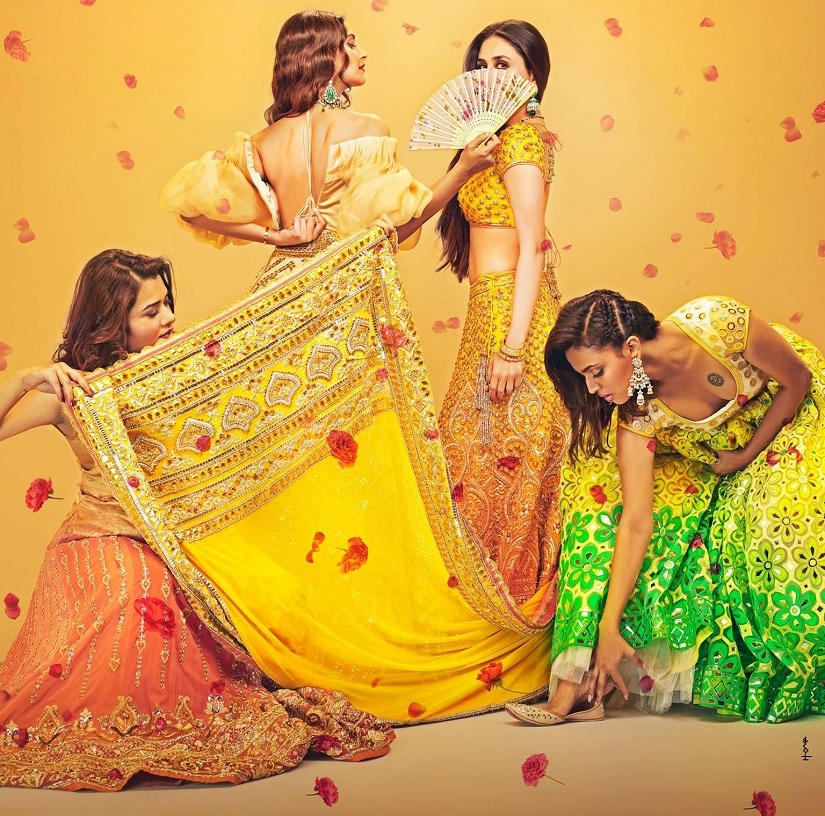
This week’s big release is the much-awaited ‘Not a Chick Flick’, Veere Di Wedding (VDW), starring Kareena Kapoor Khan, Sonam K Ahuja, Swara Bhaskar and Shikha Talsania. Directed by Shashanka Ghosh, who earlier helmed Khoobsurat for producer Rhea Kapoor, returns with a promising concept that tries to explore female friendships, which was largely left unexplored in Bollywood. What could have easily been the female Pyaar Ka Punchnama, thankfully, does not end up being a show of misandry.

As it is evident from the trailer, the movie is the story of four childhood girl-friends, whose friendship is thicker than their bonds with their families. Kalindi Puri (played by Kareena Kapoor) is a commitment phobic girl, who finally agrees to get married to her long-time boyfriend, Rishabh Malhotra (played by Sumeet Vyas). Owing to her disturbed childhood, Kalindi AKA Kalu finds families and relatives to be claustrophobic and develops a cold-feet after meeting her fiance’s loud and large family. Her best friends or veeres as they call themselves, arrive to support Kalu. The first Veera, Avni Sharma (played by Sonam Kapoor) is a ‘Divorce Lawyer’, whose mother is relentlessly pursuing her to get married. Then comes Meera Sood (played by Shikha Talsania), mother to a two-year-old kid from an American husband. And the last one, Sakshi Soni (played by Swara Bhaskar), a motor-mouth firebrand on the verge of a divorce. The movie is essentially about how the Veeres help each other face their demons, generously showered with profanities from Delhi.

Image result for veere di wedding

Director Shashanka Ghosh, much like his previous film Khoobsurat, makes the movie over-the-top at certain places. The entire childhood sequence seems contrived and so do the flags outside Meera’s house in USA. And like Khoobsurat, VDW suffers from half-baked characters and the lack of a depth or emotional connect with the audience. If you compare this with other major movies about friendship, like Zindagi Na Milegi Dobara or Yeh Jawani Hai Deewani, it is noticeable that the director in such cases gives some time for characters to develop an emotional connect on screen, which is missing in the case of VDW. With a crisp run time of about two hours, the makers could have elaborated on the backgrounds of each of these characters, helping us build a connection. Just like Khoobsurat, VDW also has a variety of vibrant characters – loud and funny Punjabi families, the typical ‘Mohalle ki Aunties’ and an openly gay couple - but some of them only end up as caricatures, for the lack of depth. There are quite a few jokes on the nouveau riche from West Delhi, with their eccentricities that are laugh worthy. But the movie seems conveniently contrived towards the climax.

Having said that, VDW is not completely unwatchable. There are some genuinely funny and real moments too – like a nervous bride gulping vodka shots on the stage and asking the photographer to edit that out or the hilarious, quintessential and loud Punjabi guy from Delhi, who is after Avni. Given the producer, Rhea Kapoor’s love for making movies about India’s elite, she chooses the problems of urban rich women to make a movie. Their problems range from avoiding an extravagant wedding to a Bentley-driving woman abusing her blackmailing husband. Some of these moments are filled with laughter, while others just seem forced.

Kareena Kapoor Khan, has the better role among the other half-baked characters. As Kalindi, she delivers a decent performance, especially with her entertaining ‘dream sequences’. She is supported well by two good actors, Swara Bhaskar and Shikha Talsania, who seem more real and have good comic timing as well. Swara, as the cuss-word lover Sakshi, is good, but towards the second half, her half-baked character starts to feel like an exaggeration. The last ill-formed character is that of Sonam K Ahuja – in the form of a perfectly styled fashionista, claiming to play a lawyer. Like in Aisha, where Sonam was in the company of two better actors, Amrita Puri and Ira Dubey, being surrounded by three better actors in VDW make her look like a weakling, in terms of her acting chops. As I mentioned earlier, the supporting cast, especially Kalindi’s fiancĂ©, RIshabh played by Summet Vyas, appear vibrant. But, not using them to their full potential makes them appear shallow. There are movies in the comedy genre like Golmaal, where the depth of the character becomes secondary as you look only for laughs. Then there are movies like Yeh Jawani Hai Deewani or Dil Chahta Hai or the guys gang flick, Zindagi Na Milegi Dobara – all the movies which treated their characters well, to build a bond with the audience. VDW sways between a Rohit Shetty madcap and a Zoya Akhtar/Ayan Mukerji emotional comedy, resulting in a slightly disappointing fare.

VDW had a great potential to be a heart-warming tale of friendship between girls, had the treatment been right. Probably, I expected a Zoya Akhtar or an Ayan Mukerji kind of craft, which left me disappointed. But, going by the hooting and cheering in the packed theater, with women filling more than two-thirds of it, Veere Di Wedding seems to have struck a chord with some viewers. Unfortunately, I am not one of them.

My Rating – 2.5/5

PS: This movie can become a B-School case study for the dozen-odd product placements done in the movie. 

Sunday, May 27, 2018

Parmanu - Movie Review


Bollywood has always made sure that patriotism is aptly shown as jingoism. Alia Bhatt’s thriller last month, Raazi, was one odd case of nationalism served right. Director Abhishek Sharma’s John Abraham starrer, Parmanu, is a movie on the famed nuclear tests in Pokhran in 1998, showered with all the quintessential cliches of Bollywood.

Ashwat Raina (played by John Abraham), is a righteous IAS officer with the Research and Strategy Department of GoI, dismissed after the failure of the Pokhran Nuclear Tests in 1995, that put India on the backfoot in the global arena. A dejected Ashwat is brought back from his self-imposed exile by the newly formed Atal Bihari Vajpayee government – a secret mission spearheaded by Principal Secretary to the PM, Himanshu Shukla (played by Boman Irani). Ashwat uses his indigenous ways of forming a highly efficient team of scientist and army personnel - by reading the interviews and magazine articles of these folks! The covert operation needs to be executed in record time, with minimal resources and while warding off the American spy satellites. The same is executed with generous dosage of melodrama, extremely contrived sub-plots and a poor display of acting skills.

Image result for parmanu

I understand cinematic liberty is taken open-handedly in Bollywood, and most patriotic movies end up being jingoistic, but my problem with Parmanu is the blurring of lines between fiction and facts. It is a well-known fact that Pokhran – II was a mission headed by former President A P J Abdul Kalam. There is no reference of him in the movie, instead, it tries to glorify Ashwat, a character it conveniently says, ‘will go down in the history unknown’. Keeping aside the distortion of facts, the movie also has some blaring mistakes in creating a world of the 90s – a volvo bus, chrono watch and practically entire wardrobe of Diana Penty – all way ahead of their time. I cannot help but compare with Raazi, where even though you know the outcome in the end, you are constantly on the edge of your seat. Sadly, the same cannot be said about Parmanu.

John Abraham, also the producer of the movie, in an interview to Rajeev Masand admitted that he did not want this movie to become falsely patriotic or jingoistic. It was not overtly patriotic like Border or Airlift, but had doses of monologues delivered by Ashwat about how the success of this mission will catapult the country into an elite league. And, he remains monotonous, like he has been in all his movies in the last 15 years. Boman Irani gets a decent role as the powerful bureaucrat, but has it is not meaty enough. Diana Penty has nothing much to do, except for uttering clichĂ©d Bollywood dialogues as ‘passcodes’. The rest of the team is just about okay, with no performance in particular to rave about. Also, a special mention of Anuja Sathe, as Ashwat’s wife Sushma, who is a complete non-performer.

I think as an audience, I have been spoilt by a better portrayal of nationalism in Raazi. Had Parmanu release a couple of weeks ahead of Raazi, maybe it would have worked for me. But then, the creative liberties are too much to be overlooked. Watch it on TV, if you must!

My Rating: 2/5

Saturday, May 12, 2018

Mahanati - Movie Review


When we talk of some of the greatest names in the film fraternity, there are a lot of examples of them being victims of alcohol abuse and depression. From Silk Smitha to Guru Dutt, there have been many illustrious names which have suffered the side-effects of glitz and glamour. Savitri, known as Mahanati and Nadigaiyar Thilagam, was one such ill-fated actress who scaled the heights of super stardom, but her crumbling married life led her into a life of financial problems and alcoholism. Mahanati, directed by Nag Ashwin, starring Keerthy Suresh, Dulquer Salmaan and Samantha Akkineni, is an ode to actress Savitri and gives us an insight into her life.

The movie opens in the 1970s, when actress Savitri slipped into Coma, as a result of her alcohol addiction. A rookie newspaper reporter, Madhuravani (played by Samantha Akkineni) and a photographer, Vijay Anthony (played by Vijay Devarakonda) begin their probe into the life of Savitri to uncover the skeletons in her closet. Now in the abys of her personal and professional career, Savitri in a vegetative state hardly has any visitors. Through the people who knew her over the years, based on radio recordings and news archives, Madhuravani narrates the story of her life – a bubbly girl from Vijaywada, being introduced to the world of movies by her uncle (played by Rajendra Prasad) at the tender age of 14. She befriends a fellow male actor, Gemini Ganesan (played by Dulquer Salmaan) and soon falls in love with him. An already married Ganesan convinces Savitri of the sincerity in his love and marries her. Much against the wishes of her family and well-wishers, Savitri moves in with Ganesan and continues with her golden run at the box-office. She is the undisputed queen of the Telugu and Tamil film industries, starring opposite all the major film stars. Savitri’s super stardom coupled with the failure of his own movies hurt Ganesan’s ego and he dips himself into alcohol. A distraught Savitri tries her best to massage the fragile ego of her husband, even offering to quit acting all together. But the inevitable was waiting to happen – her personal life begins to fall and her addiction to alcohol make her vulnerable to being cheated, leading to her downfall.

Image result for mahanati

The movie works majorly because the actors and the technicians deliver an impact on the audience. It is a daunting task to encapsulate an entire lifetime of a person in a three-hour run time. The screenplay by Siddhaarth Sivasamy deserves to be applauded. The movie goes back and forth in time, and showcases all the major milestones in Savitri’s life. Her character is molded well right from her childhood till her death. Also, a special mention to the Director of Photography, Dani Sanchez-Lopez, for alternating between sepia, vintage and current scheme of colors. And finally, the music by Mickey J Meyer, is beautiful and punctuates the story well.  

As for the performances, the movie boasts of a rich gamut of stars– some in a pivotal role while others in a cameo. Samantha Akkineni as the narrator has a relatively small, yet meaty role. She acts extremely well within the scope of her character. Vijay Devarakonda, as the photographer with his heart set on Madhuravani, has a small part as the unintentionally funny colleague of hers. Dulquer Salmaan uses his raw attractiveness to his advantage. His graph as an actor goes from being a chivalrous man to a jealous husband, and he plays it with equal aplomb. The rest of the cast also delivers an honest performance, especially Rajendra Prasad. But it is the captain of the ship, Nag Ashwin and his leading lady, Keerthy Suresh, who deserve all the applause and accolades. The director’s brilliance is at display in his way of story-telling and the ease with which he takes us back in time. Keerthy Suresh in the titular role is fantastic as Mahanati Savitri. Blessed with an equally expressive face as Savitri, Keerthy gets the most well-written character in the movie and digs her teeth deep into it. From a mischievous 14-year old who idolizes ANR, to a young girl madly in love with a much-married man, to a delusional superstar at the brink of her crumbling life – she is brilliant!! Her acting prowess clubbed with her beauty make her a treat to watch. In certain scenes, especially the one after her weight gain, she is a spitting image of Savitri herself!

While the movie leaves you with a heavy heart and lump in the throat, it is a movie that is deserved to be watched. If nothing else, watch it for the fine performances and a great cinematic experience.

My Rating – 4/5

P.S: On the flipside - The length and the off-track subplot between Madhuravani and Vijay Anthony seemed not to be helping much with the main track.

Raazi - Movie Review


In the recent past, Bollywood has seen quite a few movies based on supposed real-life incidents of patriotism, such as Rustom, Airlift or Ghazi Attack. But Meghna Gulzar showcases a realistic story of nationalism, without demonizing the adversary – something we rarely see in the pseudo-patriotic movies of today. Based on a book, ‘Calling Sehmat’ by Harinder Sikka, Raazi starring Alia Bhatt is a riveting tale of an Indian spy married into a Pakistani family, to provide intelligence during the 1971 Indo-Pak war.

Sehmat Khan (played by Alia Bhatt) is a young Kashmiri girl, who is trained and sent to Pakistan, in the guise of a bride of a Pakistani Army Officer, Major Iqbal Syed (played by Vikky Kaushal). Iqbal’s father is a high ranking officer in the Pakistani Army and so is his brother. In the words of Sehmat’s trainer, Indian Intelligence Officer, Khalid Mir (played by Jaideep Ahlawat), Sehmat is ‘Hindustan ki Aankhein aur Kaan’ in Pakistan. Underneath the doting wife and a dutiful daughter-in-law, Sehmat is a trained spy who passes crucial information to her handlers in India, that led to India’s win in the 1971 war. Though she is equipped with all the skills required as a spy, her innate quality of vulnerability makes her extremely real. Her transition is beautifully showcased by Meghna Gulzar and her co-screenwriter, Bhavani Iyer. From being a girl who flinches at a small cut in her feet, to strengthening her skills at fights and self-defense. From being an innocent girl who would not let even a squirrel die under a car, to becoming a soldier in the line of duty.

Image result for raazi

One of the best things about Raazi is that it is never pretentious nor does it ever display over-enthusiastic nationalism – there are no chest-thumping sequences, no over-the-top patriotic dialogues and not a single contrived scene, like the ‘Saare Jahan Se Achha’ scene in Ghazi Attack. Also, Pakistan is not demonized, they are shown as sensible people fighting in their interest. While Meghna Gulzar has already proven her mettle with a brilliantly crafted ‘Talvar’, she repeats similar work that is nearly perfect. The movie is crisp and interesting, despite a slow and gritty pace. I call it near perfect because I found the final 20 minutes towards the climax slightly wavering. Special mention of the Cinematography by Jay Patel and the Art direction for creating the atmosphere in the 1970s.

The movie also boasts of a perfectly cast ensemble. All the actors fit their characters very well and deliver an authentic performance. Vikky Kaushal, as Sehmat’s husband delivers a subdued performance with never being over-dramatic. While the rest of the cast is also top-notch, special mention to Jaideep Ahlawat as Khalid Mir, Sehmat’s trainer, who shows a stern, yet a caring side. As I mentioned in my opening notes, Raazi is an Alia Bhatt show all the way. She is brilliant as the petite, vulnerable and guilt-ridden Sehmat, who puts the interest of her nation before hers. Though she is a trained spy, she is not a cold-blooded soldier – she has her vulnerabilities that make her extremely real. One of the best scenes is the one where she drives a Jonga – she is burdened with guilt and pain, but puts her duty over it. It is praiseworthy how a 25-year old plays such a complex character and never goes off-key even in a single scene. With every movie of hers, she seems to be outdoing herself.

Alia Bhatt and Meghna Gulzar have revalidated their talent and craft with Raazi. I hope it paves the way for more such realistic movies on India, sans the fake nationalism.

My rating: 4/5 (1 of this is exclusively for Alia)